Frisco sits across heavy Houston black clay soils stretching across Collin County and Denton County. These shrink-swell clays pull away from monolithic post-tension slabs during triple-digit July heat and swell against…
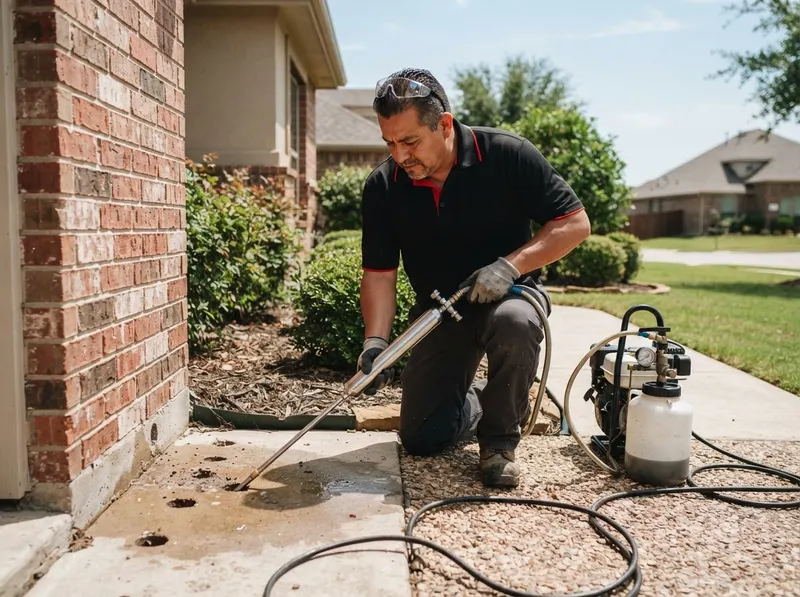
Frisco sits across heavy Houston black clay soils stretching across Collin County and Denton County. These shrink-swell clays pull away from monolithic post-tension slabs during triple-digit July heat and swell against concrete during spring rainstorms. This repetitive movement forms sub-slab voids and hairline fissures along plumbing penetrations. Native eastern subterranean termite colonies exploit these pathways, building mud shelter tubes over slab edges in communities like Newman Village, Stonebriar, and Phillips Creek Ranch. Traditional spray-and-pray perimeter surface treatments fail against subterranean species because workers tunnel deep underground. A proper subterranean termite soil treatment utilizes non-repellent liquid termiticides, such as fipronil formulations, mixed at exact label dilution rates. Because worker termites cannot detect the active ingredient, they track the chemistry back into the sub-slab nest, transferring the active agent to the reproductive queen through grooming and social food sharing within 14 to 90 days.
Selecting a continuous liquid soil treatment over localized spot baiting depends on foundation architecture. If active mud shelter tubes span stem walls or structural framing near ground contact in properties across The Trails or Griffin Parc, a continuous chemical barrier provides immediate perimeter saturation. If an exterior patio has extensive pavers, soil trenches are excavated directly adjacent to the foundational edge, dug 6 inches wide and 6 inches deep, with termiticide applied at 4 gallons per 10 linear feet per foot of depth, according to standard regulatory label rates. Attached garage slabs and flatwork in neighborhoods such as Starwood and Richwoods require precision drilling every 12 inches to inject liquid directly into sub-slab soil, preventing subterranean colonies from bypassing exterior soil zones. Trade-offs exist: liquid barriers require focused drilling into secondary exterior flatwork, whereas bait stations require recurring quarterly station inspections to verify active consumption.
The process follows a precise four-step clinical workflow. 1. A technician conducts a 45-point crawlspace, weep hole, and stem wall structural inspection to locate active mud tubes and identify plumbing clusters near utility penetrations. 2. Technicians dig clean 6-by-6-inch access trenches along all soil-contact slab perimeters. 3. Specialized low-pressure rodding equipment injects termiticide directly into backfill soil and sub-slab voids beneath attached flatwork. 4. Access holes in concrete are patched flush with custom-matched core plugs, and trench soil is returned without disturbing lawn sod or landscaping beds.
Every job gets a firm, written price after a free on-site visit.
Tell us about your subterranean termite soil treatment job in Frisco and we'll send a clear, written quote, usually the same day.
 Prairie Fox Pest Control